Semi Accident Attorney Explains Truck Cargo Securement
A Semi Accident Attorney Explains the Federal Framework
A chain can look sturdy and still provide too little restraint for a semi truck’s shipment. Likewise, several straps can meet a minimum count yet lack the required capacity. Federal cargo securement rules address these details because appearance alone cannot establish safety.
An experienced semi accident attorney examines how the entire securement system works together. That review includes the restraints, attachment points, cargo dimensions, and applicable equipment standards.
My goal in writing this article is to educate Kentucky and Indiana motorists so they have a clearer understanding of commercial trucking safety. I will explain several important distinctions within the Federal Motor Carrier Safety Administration’s cargo securement framework. In the event you suffer a serious truck wreck injury, they may be able to spot truck accident liability and seek legal help.
What is the FMCSA?
The Federal Motor Carrier Safety Administration, or FMCSA, operates within the U.S. Department of Transportation. Its primary mission is to prevent deaths and injuries involving commercial motor vehicles, including large trucks and buses.
What Does the FMCSA do?
The agency pursues this goal through safety regulations, enforcement, research, and education. It develops commercial driver licensing standards, strengthens equipment requirements, and targets high-risk carriers. FMCSA also works with state and local agencies to improve highway safety.
FMCSA’s Mission
Cargo securement rules support that mission by addressing freight that shifts within trucks or falls into traffic. An experienced semi accident attorney reviews these standards when evaluating whether a truck’s securement system met federal requirements.
A Semi Accident Attorney Review
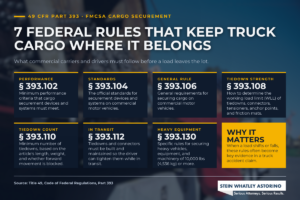
FMCSA’s cargo securement rules addresses cargo-carrying commercial motor vehicles operating in interstate commerce. It describes both general securement rules and requirements for specific commodities. You want a semi accident attorney that knows both the general and specific details of securement.
The overview uses the phrase “new rules” because it explains requirements that took effect in January 2004. That wording does not announce a new 2026 regulation. The underlying regulations provide the detailed standards for evaluating a particular shipment.
A careful review begins with the freight itself. Its weight, dimensions, shape, and handling characteristics determine which requirements apply. Then the semi accident attorney considers how the carrier selected and installed the restraints. This sequence matters. Counting visible straps before identifying the shipment can overlook a special rule or an inadequate component.
Breaking Strength and Working Load Limit Serve Different Purposes
49 CFR § 393.102 distinguishes breaking-strength criteria from working-load-limit criteria. These terms describe different limits, so a reviewer should not substitute one for the other.
For breaking strength, the regulation specifies separate conditions involving 0.8 g forward deceleration and 0.5 g rearward or lateral acceleration. Its working-load-limit criteria use 0.435 g forward, 0.5 g rearward, and 0.25 g lateral conditions.
The regulation also addresses vertical restraint. For cargo that the vehicle structure does not fully contain, securement systems must provide downward force equivalent to at least 20% of cargo weight. The section recognizes equivalent securement methods that satisfy its requirements.
These distinctions prevent an oversimplified analysis. A statement that a strap can withstand a certain force does not answer every compliance question. The semi accident attorney must examine the relevant rating and the complete securement arrangement.
A Semi Accident Attorney Must Check the Weakest Component
Under § 393.108, the lowest-rated component or anchor point controls a tiedown’s working load limit. A stronger chain cannot compensate for a weaker connector.
Consider a hypothetical assembly with a 6,600-pound chain and a 4,700-pound tensioner. Assuming all other components and anchor points support at least 4,700 pounds, the assembly’s working load limit remains 4,700 pounds.
Manufacturer markings can establish ratings. When materials lack working-load-limit markings, the regulation supplies tables and default classifications. For example, an unmarked welded steel chain receives the rating for grade 30 proof coil chain.
FMCSA’s cargo securement rules explain that federal rules do not require anchor-point rating labels. However, the absence of a labeling requirement does not remove the need to evaluate anchor-point capacity. A semi accident attorney therefore looks beyond the most prominent rating. Every connection in the restraint system matters.
A Semi Accident Attorney and Tiedown Math
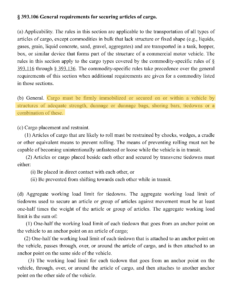
49 CFR § 393.106 requires an aggregate tiedown working load limit of at least half the article’s weight. It also assigns different contributions based on the attachment arrangement.
A tiedown running from the vehicle to an attachment point on the cargo contributes half its working load limit. Certain arrangements returning to the same side also contribute half. An over-cargo tiedown connecting opposite sides contributes its full working load limit.
Suppose a 12,000-pound article uses two qualifying opposite-side tiedowns, each with a 3,000-pound working load limit. Together, they provide the required 6,000-pound aggregate capacity. Two direct vehicle-to-cargo tiedowns with those same ratings contribute only 3,000 pounds.
Length creates another requirement. Under § 393.110, an ordinary 12-foot article without forward blocking generally requires three tiedowns. That count applies independently of aggregate capacity. This example shows why neither a rating label nor a strap count establishes compliance by itself.
A Semi Accident Attorney Reviews Protection and Adjustability
49 CFR § 393.104 prohibits damaged or weakened components that adversely affect securement performance. It also prohibits knots in tiedowns and securing devices. Repairs must follow applicable standards or manufacturer instructions. Issues related to repairs and maintenance may involve third parties that may have to be a named defendant in a semi accident lawsuit.
Edge protection becomes mandatory when contact with cargo would expose a tiedown to abrasion or cutting. That protection must withstand abrasion, cutting, and crushing. Vehicle structures and anchor points must also possess adequate strength and avoid performance-compromising damage.
For example, a sharp cargo corner may require protection even when the strap otherwise has sufficient capacity. The rating does not eliminate the contact hazard. 49 CFR § 393.112 adds an adjustability requirement. Tiedowns, connectors, or attachment mechanisms must allow the driver to tighten them during transit. The requirement excludes steel strapping. Together, these provisions address practical equipment performance throughout transportation.
Heavy Machinery Requires Additional Securement Measures
A wheeled or tracked machine weighing at least 10,000 pounds falls within § 393.130’s heavy-equipment requirements. Examples include bulldozers, tractors, and front-end loaders.
The rule requires at least four tiedowns to restrain movement forward, rearward, sideways, and vertically. Attachment locations must sit as close as practicable to the equipment’s front and rear, or use specifically designed mounting points.
Preparation matters as well. Carriers must completely lower accessory equipment, such as hydraulic shovels, and secure it to the transported vehicle. They must also restrain articulated vehicles against articulation during transit. Therefore, securing the main machine does not complete every required task. The review must also address its accessories and moving sections.
Speak With a Semi Accident Attorney About Securement Concerns
Technical cargo requirements can raise questions that a general description of a semi truck collision cannot answer. A semi accident attorney can evaluate which standards apply and whether the securement arrangement satisfied them. Our team of semi accident attorneys will help you get you the full and fair compensation you deserve after a truck wreck.
Stein Whatley Astorino, PLLC represents injured people in Kentucky and Indiana. If you suspect a semi truck’s restraints or equipment contributed to your injuries, contact our semi truck law firm. We can review your circumstances, explain the relevant issues, and discuss your legal options.
Case evaluations are free and confidential. 502.533.4750.
This article provides general information and does not constitute legal advice.